
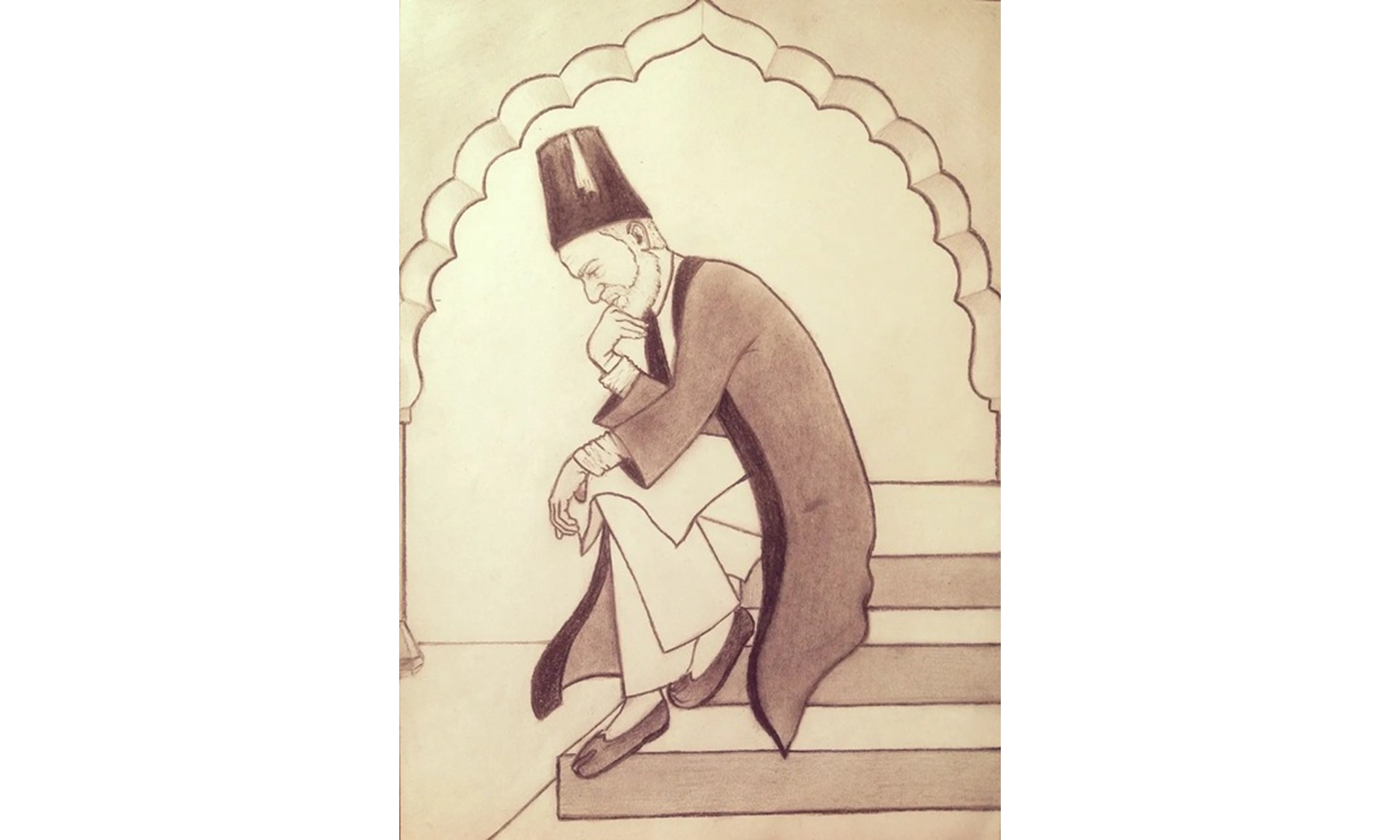
Anjum Altaf and Amit Basole, authors of Thinking With Ghalib: Poetry for a New Generation, explore Ghalib not simply as a poet whose ghazals continue to be sung, but as a philosopher and thinker whose ideas remain strikingly relevant today.
Why have we allowed Ghalib the thinker to slip from public consciousness? And what might we discover if we began to think with him rather than simply admire his poetry? Read the essay to encounter one of India’s most remarkable intellectual voices anew.
Ghalib spoke of his death a number of times in his poetry, always in playful and witty ways. Take this So What question:
ġhālib-e ḳhastah ke baġhair kaun-se kām band haiñ
roʾiye zār zār kyā kījiye hāʾe hāʾe kyūñ
Life will go on without this frail and weary Ghalib
Why should you bother to weep and wail
In another verse he hints why the above may be a rhetorical question:
huʾī muddat kih ġhālib mar gayā par yād ātā hai
vuh har ik bāt par kahnā kih yūñ hotā to kyā hotā
Ghalib has long been gone but we remember him still
He was the one perpetually asking the What If questions
And then he leaves no doubt of what he thinks of himself and the perspicacity of those who are not aware of him.
pūchhte haiñ vuh kih ġhālib kaun hai
koʾī batlāʾo kih ham batlāʾeñ kyā
Who is Ghalib, they ask
Tell us should we even bother to tell them
Indeed, the world went about its business after Ghalib left (in 1869) with an increasing restlessness and pace that may have both impressed and dismayed him. Today Ghalib comes to us mostly in the form of music—a few popular ghazals that are sung and re-sung. Anyone with a cursory knowledge of Urdu literature has heard his name and knows that he was a great poet. But very few may be able to say what his thought was all about. Ghalib the pop icon remains with us, but Ghalib the thinker has gone missing from our lives. An important reason for this is that we do not teach him adequately in schools.1
Ghalib is not the only person who is dead. Homer is dead; so are Plato and Aristotle; Rumi, Saadi, and Hafez; Chaucer, Shakespeare, Milton, Keats, Byron, and Shelley. They all died well before Ghalib, some preceding his departure by two centuries. Yet all these dead are very much alive. Homer keeps getting retranslated and turned into movies; Shakespeare has a reinterpretation every few years; Rumi, in translation, is the most-selling poet in the USA; and the rest are regularly featured in contemporary literary criticism.
So what is the difference between Ghalib and these other dead who remain present in our midst? Is Ghalib not in the same league? Those familiar with his work will not concede that for a moment. Here is Professor Brian Spooner of the University of Pennsylvania: “Ghalib is a poet, a philosopher, a scholar, a religious teacher, a spiritual guide. He is the Plato and Aristotle of the Persianate/South Asian Islamicate world.” We might add that the Persianate world was much larger than Ancient Greece and that, in addition to the above, Ghalib was also an incomparable diarist, historian and social scientist—his letters recounting the everyday occurrences during the 1857 mutiny set a new trend in Urdu prose writing.2 His history of the same is the only first-person account of the event. As for being a social scientist, consider this verse:
banā kar faqīroñ kā ham bhes ġhālib
tamāshā-e ahl-e karam dekhte haiñ
In the guise of a mendicant, Ghalib
We observe the doings of generous folks
What is this if not the most modern form of participant-observation research?
The bottom line remains that despite the high regard in which Ghalib is held, both by those who have studied him and those who only know him by a few popular ghazals, his thought is much less familiar to us at the popular level than that of the other deceased named above. One reason for this variance seems fairly obvious. Recognition does not drop from the sky nor are geniuses discovered at random by succeeding generations. Rather, societies that value their giants go to great lengths to promote and transmit their legacy in a systematic manner. The simplest mechanism is to include their work in school curricula. Review the regularly updated K-12 syllabi of American and British schools and note how many classical works of literature are familiarised before students graduate from high school.
Consider, in this context, my (ironic) example—by the time I graduated high school in Lahore I had devoted a year each to Julius Caesar and Macbeth, a year to Far From the Madding Crowd and The Thirty-Nine Steps, and two years to An Anthology of Longer Poems in English. But no Ghalib. Invisible—out of sight, out of mind.
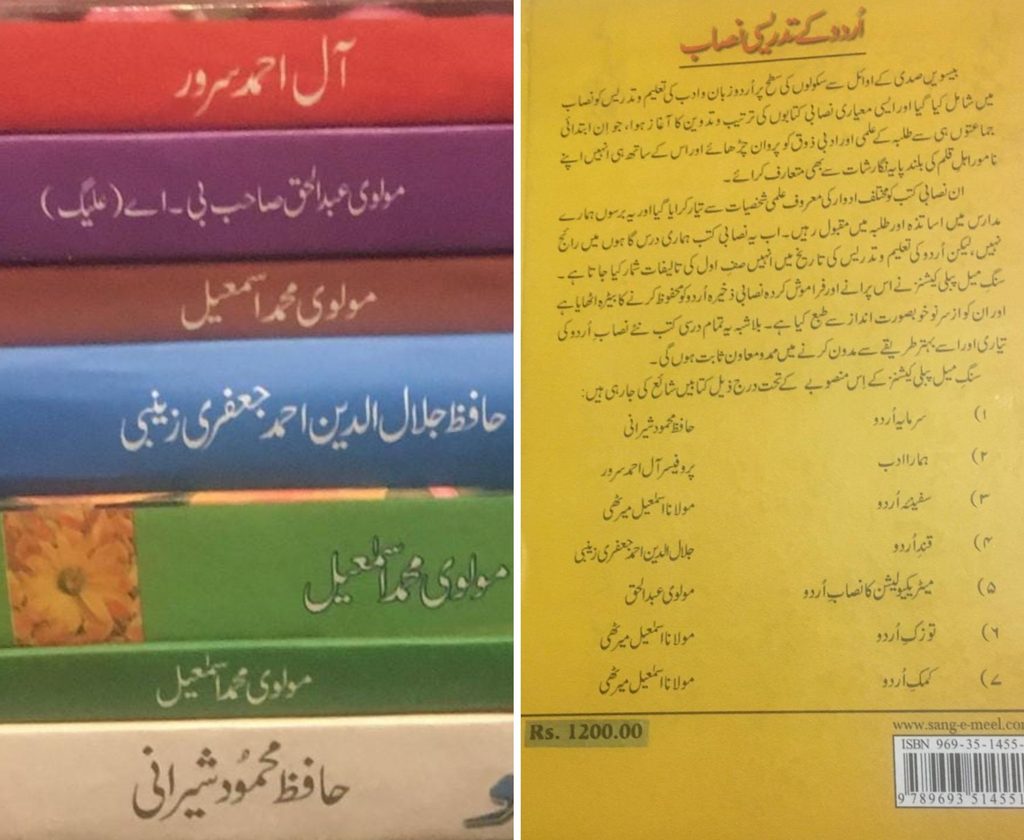
Even more ironic is the fact that a lot of the treasures of Urdu literature including Ghalib (poetry, letters, commentary on the poet) were included from Class 5 onwards in textbooks prepared by eminent scholars since the 1810s for Anglo-Verenacular schools in British India. The Introduction to Aal-e Ahmed Suroor’s 1940 selection for high schools in Lucknow (hamaara adab) states the purpose explicitly: “ye baat bahut vaazeh hai ke dunya bhar ke mukhtalif mulkoN ke adab aur zabaanoN ke farogh meiN adab ke intikhaabi silsiloN ne bahut aham kirdaar ada kiya hai” (This much is very obvious that in every country the promotion of literature and language has been greatly promoted by the series of introductory selections). Comparing the table of contents of a Class 5 textbook from that period to one in use now is eye-opening. The steep decline is hard to comprehend and one wonders if it can be accidental.
Another institution for conferring recognition is that of the Poet Laureate. In the UK, where the tradition began in 1616, the Poet Laureate is appointed by the monarch on the advice of the Prime Minister. The first Laureate was John Dryden and the list has included Southey, Wordsworth, Tennyson, Masefield and Ted Hughes. In the USA, the tradition was started in 1937 and has included Robert Lowell, Elizabeth Bishop, Robert Frost, Stephen Spender and Joseph Brodsky. In its own fashion, the tradition existed in India as well with Ghalib being the poet to the last king of the Mughal dynasty. But since then it has been discarded much like the textbooks mentioned earlier, a clear sign that literature is no more considered worthy of patronage or a mark of being cultured.3
This reminds me of an incident from many years ago. An Iranian professor was giving a talk on Omar Khayyam to a largely American audience at the Library of Congress in Washington, DC. Somewhere in the presentation he sensed perplexed looks and stopped with the remark “How can I explain to you the place of poetry in Irani culture?” He thought for a full minute before continuing “Poetry is to Iranians what baseball is to Americans.” No wonder Saadi and Hafez have been part of every home for close to a century and poetry is in the air that children breathe.
It is often asked if Partition contributed to the decline of interest in Ghalib. To some extent it must have—Urdu being reduced to an exquisite museum piece in India and subversive thought outlawed in an increasingly authoritarian Pakistan. But I believe the greater impact has been the rise of hypercapitalism since the 1970s in which education morphed from a means to acquire culture to a pursuit for lucrative employment. The ascendance of STEM and English as passports to wealth and status was the last nail in the coffin of aesthetics and literature. From an essential part of culture they slid to the lowly position of nostalgic afterthoughts.
So, if Ghalib is becoming unknown, it’s on us. It is as if Ghalib had anticipated this outcome with this verse:
bachte nahīñ muvāḳhażah-e roz-e ḥashr se
qātil agar raqīb hai to tum gavāh ho
You won’t escape the reckoning of Judgement Day
The rival was the assassin but you were a witness
To grasp what we are doing, imagine the Taj Mahal enclosed in a black tent with no one allowed to see it. Ghalib is the Taj Mahal of Indian literature. In fact, he is much more valuable because the Taj does not speak4 while pearls of wisdom keep flowing from Ghalib’s pen.
There is, of course, a big difference in our experiencing the splendour of the Taj and of Ghalib—the former is a visual phenomenon requiring just a pair of eyes unmediated by any medium; the latter is an aural phenomenon mediated by words. If you don’t know the language, Ghalib is a closed book and no more than noise.
Add to it the fact that Ghalib’s poetry employs a form, the ghazal, that is pretty much untranslatable. We know many other great poets writing in unfamiliar languages through excellent translations—Neruda, Rimbaud, Rilke, Pushkin, to name a few. But there is no Ghalib translation worth the name because of the peculiarity of the ghazal form. Instead, there are explanations—more than a dozen highly regarded commentaries offering an explication of every single couplet in his collection of Urdu verse. These are collected in a very user-friendly online archive in English by Professor Frances Pritchett of Columbia University; the site presents every single couplet in Roman, Urdu and Hindi scripts.5
However, commentaries, no matter how good, have their limitations. First, a commentary is like a dictionary—you have to know what you are looking for before you go to it and if you don’t know Ghalib there would be no reason to consult one. Second, a commentary will give you the meaning but with Ghalib that is not what you are looking for. What you seek is the exhilaration of thinking with him, turning the questions he asks over in your mind and coming up with your own answers. Only once you have savoured that intellectual experience, should you refer to a commentary to see how others have interpreted the same text.
The profusion of commentaries on Ghalib is owed to the fact that there are no unambiguous interpretations of his couplets.6 Ghalib expresses very profound thoughts in a dozen or so words each of which is multi-layered and packed with meanings. Ghalib was a writer of such calibre that he could easily have been clear had he so wanted. The ambiguity is deliberate which is also the reason why his poetry remains fresh and recreates itself for every new generation.
Consider the possibilities in this seemingly simplest of simple couplets that Frances Pritchett calls a ‘meaning-machine’:
When there was nothing there was God
Had I been nothing, what might I have been
This couplet is worth spending time with before using the hyperlink to access the commentary.
Ghalib has expressed this characteristic of layered meanings in two very well-known couplets:
ganjīnah-e maʿnī kā t̤ilism us ko samajhye
jo lafz̤ kih ġhālib mire ashʿār meñ āve
Consider it a magic key to the treasury of hidden meanings
The word that you encounter in my verse
And
āgahī dām-e shanīdan jis qadar chāhe bichhāʾe
muddaʿā ʿanqā hai apne ʿālam-e taqrīr kā
Awareness can spread its net however so it wants
The meaning of my words shall still manage to escape
To realise the worth of Ghalib consider another analogy. Imagine dying of thirst in a desert while unbeknownst to you is a fresh water spring 500 metres away. Now imagine dying of ignorance in an intellectual desert while a spring of knowledge or a mine of wisdom lies within reach. Ghalib is that treasure-house of meaning whose pearls are there for the picking if only we could see them.
Ghalib is unique in many ways—he asks questions without providing answers, is brief, profound, witty and relevant to our contemporary world, all in language requiring at most a dictionary for the modern individual unschooled in the tradition of the nineteenth and twentieth centuries. There are many great philosophers in history but to access most of them one needs a degree in philosophy—even a Heidegger or Foucault for Idiots won’t get one very far. Ghalib, on the other hand, is perhaps the only people’s philosopher offering the wisdom of the ages in a pithy user-friendly form. Perhaps the form is so seductive that we have preferred to set him to music turning him into entertainment rather than a source of enlightenment. This is a great disservice that reflects poorly on our society.
Almost all of humanity’s wisdom is contained in its poetry and its political importance is grossly underestimated. Poetry can clarify political concepts, enrich our imagination with new ideas and possibilities, and help us see our world in a universal perspective. A recent illustration of this was the rapidity with which Faiz Ahmed Faiz’s hum dekheNge was translated and sung across India during the protests a few years ago.
A few Ghalib couplets on the theme of faith will illustrate his range, running the gamut from profundity to witticism and subversion.7
nahīñ kuchh subḥah-o-zunnār ke phande meñ gīrāʾī
vafādārī meñ shaiḳh-o-barhaman kī āzmāʾish hai
There is no grip in the noose of prayer-beads and sacred-thread
The test of the shaikh and brahman is in fidelity
vafādārī bah shart̤-e ustuvārī aṣl-e īmāñ hai
mare but-ḳhāne meñ to kaʿbe meñ gāṛho barahman ko
Fidelity with constancy is true faith
If the Brahman dies in the temple bury him in the kaabah
hai pare sarḥad-e idrāk se apnā masjūd
qible ko ahl-e naz̤ar qiblah-numā kahte haiñ
The object of our veneration lies beyond perception’s reach
To those who see, the kaabah is a qiblah, nothing more
bandagī meñ bhī vuh āzādah-o-ḳhvud-bīñ haiñ kih ham
ulṭe phir āʾe dar-e kaʿbah agar vā nah huʾā
Even in servitude we are so free and self-regarding that we
Turned and came back if the door of the kaabah did not open
t̤āʿat meñ tā rahe nah mai-o-angabīñ kī lāg
dozaḳh meñ ḍāl do koʾī le kar bihisht ko
Lest obedience be tainted by desire for wine and honey
Someone take Heaven and fling it into Hell
ham ko maʿlūm hai jannat kī ḥaqīqat lekin
dil ke ḳhvush rakhne ko ġhālib yih ḳhayāl achchhā hai
We know the reality of Paradise, but
It’s a good thought to keep the heart content
Consider the progression of thought in this set of couplets that belong to different ghazals. In the first, Ghalib makes it clear what he considers true faith—fidelity to a set of beliefs, not adherence to rituals. In the second, he asserts the extreme to which he will go in support of that position—if the Brahman has been steadfast to his belief in the temple, he has earned a burial in the kaabah, the holiest of holy places for Muslims.
In the third, Ghalib qualifies the significance of the kaabah—it is not a ritualistic site of veneration, only a pointer to something more meaningful. In the fourth, he makes clear the terms of his faith—obedience is not one-sided servitude. In the fifth, he qualifies belief—it has to be principled and unconditional, not observed for reward or out fear of punishment; his test for faith is the absence of Heaven and Hell.
Finally, in the sixth, Ghalib subverts the very notion of Heaven. Here it helps to be familiar with the Urdu term sabz baagh dikhana, literally ‘leading down the garden path,’ something people go along with because it makes them feel good—like the promise of Viksit Bharat, perhaps. In between the lines, Ghalib is saying that if sabz baagh (beautifully characterised by Abdul Haleem Sharar as baagh-e aarzu) is so common in this world, what prevents it in the celestial domain.
Ghalib goes much further about the celestial promise in this Persian couplet:
guftand huur o kausar o dadand zauq-e kaar
maneh ast naam shahid o mai aashkaar burd
Wine and women are promised there to make us slog
Here, where it is forbidden to mention their names
What kind of logic is that? It’s the sabz baagh in spades but one for which we also have to forego the pleasures that are right at hand. Make up your mind—are these things forbidden or not?
A concluding tribute to Ghalib is conveyed by the extraordinary standard he displayed in the selection of verses that made it into his spare edited collection. Here are two couplets he rejected that are still celebrated by connoisseurs for the expression of his vision:
hai kahāñ tamannā kā dūsrā qadam yā rab
ham ne dasht-e imkāñ ko ek naqsh-e pā pāyā
God, where shall I place the second step of desire
This desert of possibilities has been exhausted in one
It is said Ghalib discarded this because he was not pleased with the repetition of the pa sound in pa paya.
And
h̅un garm̅i-yi nish̅at-i tasavvur se naghmah-sanj
main ‘andal̅ib-i gulshan-i n̅a-̅afr̅idah h̅un
My song is born of the fire of the exhilaration of imagination
I am the nightingale of a garden yet to be created
This couplet was discarded because it was part of a ghazal that was too Persianate in its construction. Yet it remains an almost perfect summary of the unlimitled imagination of Ghalib.
Ghalib darguzasht; zindabaad Ghalib (Ghalib is dead; long live Ghalib).
1 This is a reworked version of a presentation by Anjum Altaf and Amit Basole (co-authors of Thinking with Ghalib) at a workshop sponsored by the Mumbai-based Usawa Literary Review on 3 October 2026. I would like to thank Amit for his inputs in the preparation of this article.
2 In no way less valuable than the celebrated record of the London plague (1663-1666) by Samuel Pepys.
3 State-sponsored literary awards do exist but they do not have the cachet of the coronation of a Poet Laureate.
4 Only the very perceptive can extract wisdom from the Taj as Sahir Ludhianvi did with his couplet ik shahanshah ne daulat ka sahaara le kar / hum ghariiboN ki muhabbat ka uRaaya hai mazaaq.
5 Another good site offering the couplets in the three scripts with the meanings of words accessible by hovering over them is https://www.rekhta.org/authors/mirza-ghalib/ghazals.
6 The celebrated critic Shamsur Rahman Faruqi has written a meta-commentary (tafheem-e Ghalib) pointing out what all other commentators have missed in a selection of couplets.
7 All the following Urdu couplets are discussed at greater length in Thinking with Ghalib: Poetry For A New Generation published in 2021 from Lahore and Delhi.
