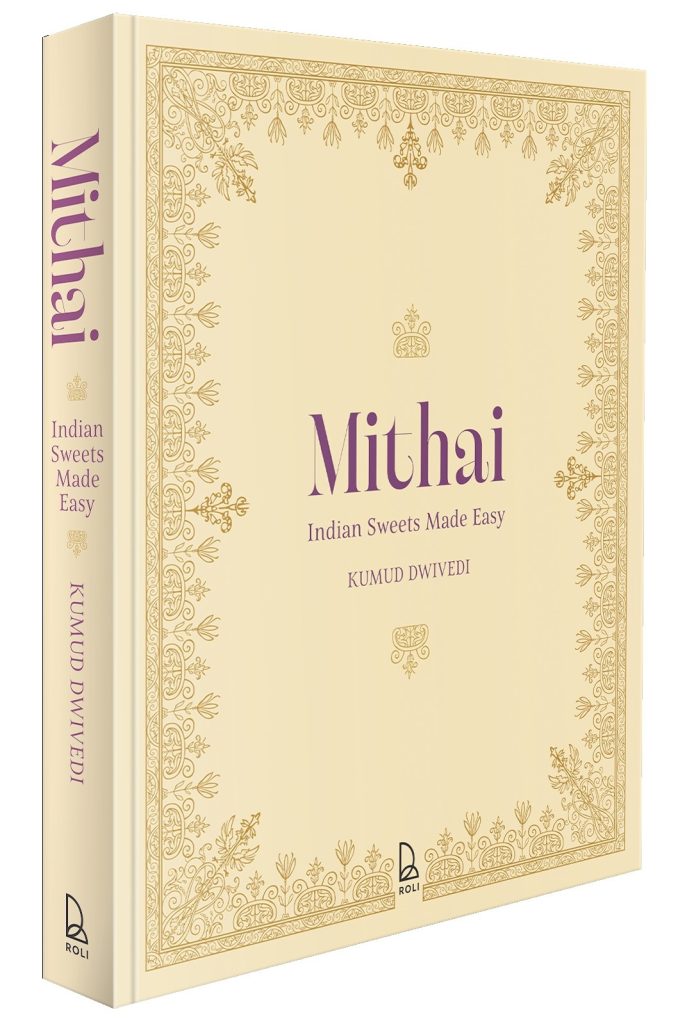
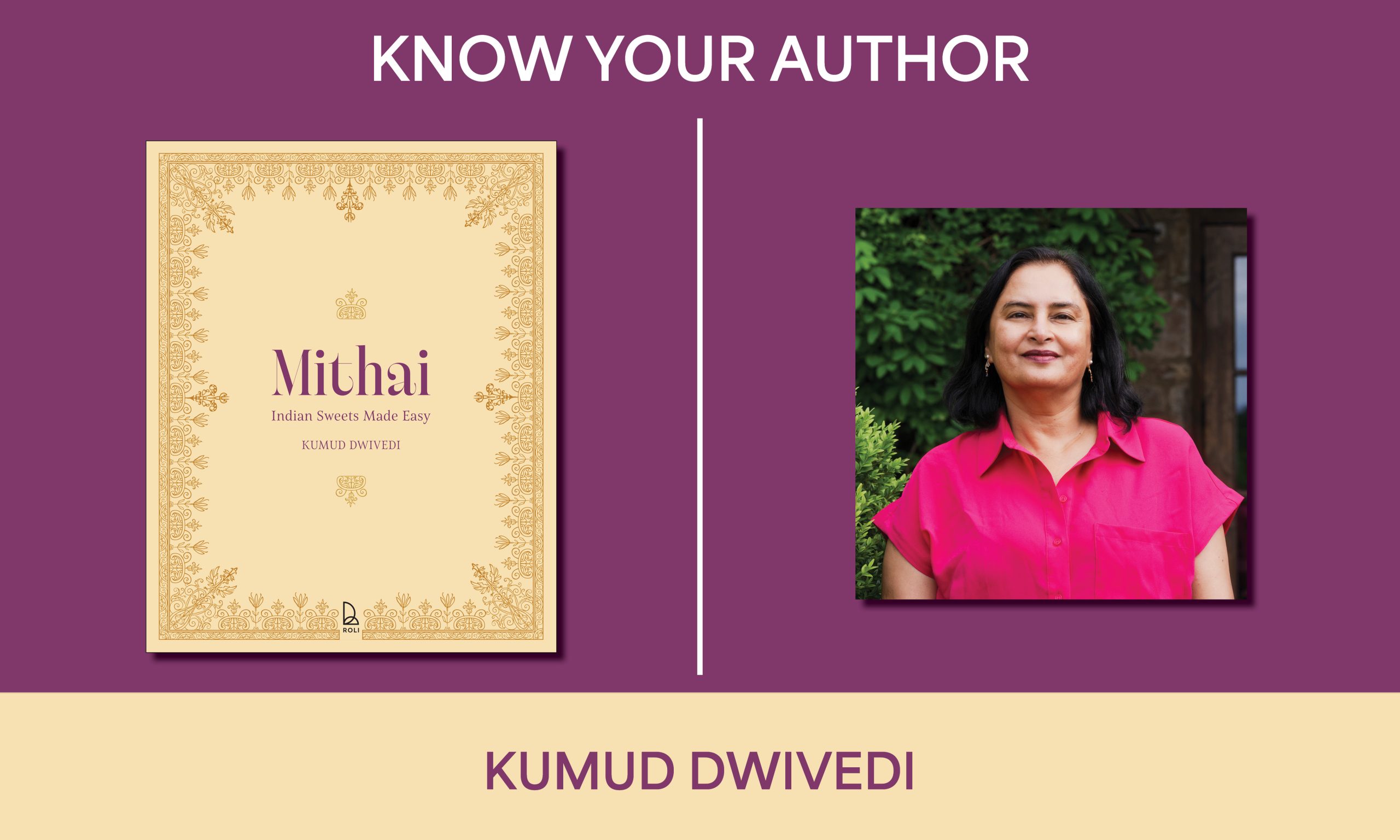
In Mithai: Indian Sweets Made Easy, renowned chef, baker and patisserie consultant Kumud Dwivedi brings a a deep understanding of India’s culinary traditions. The cookbook is a celebration of India’s extraordinary legacy of sweets, exploring how mithai shapes India’s celebrations, memories, and everyday life. Here is a candid interview we conducted with her.
1. Mithai is described as tracing a cultural and culinary legacy. What was the moment you realized this book needed to exist?
Having authored a coffee table book on western desserts earlier, I found myself constantly asked – why there wasn’t a similar body of work celebrating our own sweets. That question stayed with me longer than I expected.
I realized Indian sweets had rarely been given the same treatment: the same research, the same regional depth, the same visual respect that western desserts routinely receive in cookbooks and media. Mithai was often treated as a monolith – ladoo, jalebi, barfi – when in reality it’s an extraordinarily diverse, deeply regional craft with centuries of history behind it. That gap felt like something worth correcting. I wanted to democratize Indian sweets the way western desserts had already been democratized – to give them the documentation, the storytelling, and the visibility they’d long deserved. That’s the moment Mithai – 60 recipes from across India – began to take shape.
2. Indian mithai is deeply tied to memory and celebration. Is there any one sweet from your childhood that still holds a special place in your heart, and why?
For me, it’s besan ladoo. I remember my mother making a big batch every winter – the whole house would smell of ghee and roasted gram flour long before the ladoos were actually ready, and that smell alone was enough to tell you something special was coming. There was always a ritual to it: standing near the kitchen, waiting to eat one warm, before it had even fully set.
Even now, one bite of a good besan ladoo takes me straight back to that kitchen. That’s the real power of mithai – it’s less a dessert and more a memory you can eat. Writing this book, I realized so many people carry a version of that same story, just with a different sweet.
3. You bridge western patisserie and Indian mithai in your work. Where do these two traditions most unexpectedly meet?
The most unexpected overlap, for me, is technique – the two traditions often arrive at the same principle through completely different histories. Sugar work is a good example: the precision needed to get a sugar syrup to the right thread consistency for a barfi is essentially the same skill French patissiers use for pulled sugar or caramel – different vocabulary, same physics.
Another place they meet is in the idea of “mother recipes” – a base that gets endlessly reinvented. Just as crème pâtissière or ganache underlies dozens of French desserts, khoya and chenna do the same for mithai – one base, transformed through technique, flavour, and shape into completely different sweets. Once you see that structural similarity, the two traditions stop feeling like opposites and start feeling like cousins who never got properly introduced.
4. Which recipe in Mithai do you consider the most technically demanding for a home cook, and what is your advice for getting it right?
If I had to pick one, it’s rasmalai. The challenge isn’t any single step – it’s that the whole dish depends on getting several delicate stages right in sequence. You need to make chenna with the correct texture, knead it just enough (not too much, not too little), shape the discs evenly, and then poach them in boiling sugar syrup at exactly the right temperature and time. Too little kneading and the discs turn hard; too much boiling and they turn dense or break apart instead of doubling in size and staying spongy.
My advice for a home cook: don’t rush the kneading stage – it should feel almost like soft dough, smooth with no graininess, and that only comes from patient kneading, usually longer than people expect. And resist the urge to peek constantly while they’re boiling; a covered pot with a steady, rolling boil is what gives you that light, spongy texture. Once you’ve nailed those two things, the rest – soaking in reduced, chilled milk – is fairly forgiving.
5. Sugar, milk, ghee, solids – the architecture of mithai is deceptively simple. What do most people fundamentally misunderstand about making Indian sweets at home?
Most people assume mithai is about following a recipe precisely – exact quantities, exact minutes on the clock. But the truth is, mithai is far more about reading the process than following it. The same “one string” sugar syrup, the same khoya, the same chenna will behave slightly differently depending on humidity, the heat of your stove, even the pan you use. What actually matters is learning to recognize cues – the sound of ghee changing, the way syrup coats a spoon, the exact moment chenna comes together without turning rubbery.
That’s the fundamental misunderstanding: people treat mithai like baking, where precision is everything, when it’s actually much closer to a live, sensory craft – closer to how our mothers and grandmothers made it, by touch, smell, and instinct rather than a stopwatch. Once you shift from “measuring” to “watching and feeling,” Indian sweets stop being intimidating and start becoming intuitive.
6. As someone trained in western patisserie, what did Indian mithai teach you that formal culinary training did not?
Formal patisserie training teaches you precision – exact weights, exact temperatures, exact timings, because consistency is the whole point. Mithai taught me the opposite discipline: patience with imprecision. There’s no thermometer in most Indian kitchens telling you the syrup has hit 105°C – there’s a grandmother testing it between two fingers. Learning to trust that kind of sensory judgment, after years of trusting scales and recipes, was humbling.
It also taught me that a recipe is only half the story. In patisserie, the recipe is often the final word. In Mithai, the recipe is just a starting point – the real skill lives in the hands of the person making it, adjusted every single time based on the ingredients in front of them. That shift – from technique as a fixed formula to technique as a living, responsive skill – is something no culinary school could have taught me. Mithai gave me that.
7. Traditional mithai making is both an art and a science. Which recipe in the book did you find most rewarding or most challenging to perfect?
That would be ghewar. It’s deceptively simple in its ingredient list – flour, ghee, sugar syrup – but achieving that signature honeycomb structure is one of the hardest things to get right and even harder to explain on paper. The batter consistency, the temperature of the ghee, and the way it’s poured in circular motions all determine whether you get those distinct porous layers or a dense, flat disc that never opens up.
I tested that recipe more times than almost any other in the book, adjusting small details – batter thickness, ghee temperature, pouring technique – until I was confident a home cook could get that honeycomb texture without a mould or years of practice. When it finally worked consistently for testers who’d never attempted it before, that was one of the most satisfying moments of writing Mithai. It reminded me that the real craft of this book wasn’t just collecting recipes – it was translating a sensory, inherited skill into something anyone could learn.
8. Across India, the same sweet often exists in several regional variations. Did you have a favourite debate or discovery while deciding which versions to include?
Yes – the ladoo debates were endless, which is actually why Mithai includes several ladoo recipes rather than just one. Almost every region has a version it considers the “real” one – besan ladoo, boondi ladoo, ragi ladoo, rava ladoo – and I quickly realized there was no neutral way to pick a single “correct” one. What fascinated me more was understanding why these variations existed at all – often tracing back to local ingredients, a regional preference for jaggery over sugar, or even climate affecting how long a sweet needed to keep.
So rather than forcing one definitive ladoo into the book, I chose to include the versions that each told a distinct story of place. It reframed the whole exercise for me – from “which ladoo is correct” to “what does each ladoo tell us about where it comes from.” That’s really the discovery the book is built on.
Mithai